Li Chaoxia, Bian Leyi, Sun Guangchao, Li Zhaoyong, Sun Yi, Yang Zaibin, Yang Weiren
Shandong Agricultural University, SD BIOTECH GROUP
Abstract: In order to study the improvement of broiler production performance by enzymatic hydrolysis of polysaccharides and Boluohui. This study selected 960 healthy 1-day-old AA broiler chickens with similar body weight and randomly divided them into 4 treatments, with 12 replicates in each treatment and 20 replicates in each replicate (see Table 1). The experiment used a 2 × 2 factorial method: treatment with 2 extracts of Platycodon grandiflorus (0 mg/kg vs. 300 mg/kg); Two yeast hydrolysate treatments (0 mg/kg vs. 75 mg/kg). Meanwhile, another 30 chickens were selected and divided into 6 replicates for the determination of endogenous metabolites and the determination of true nutrient utilization efficiency. The experiment is divided into two stages (0-21d; 22-42d). The research results showed that compared with the control group, the addition of 75mg/kg Boluohui extract or 300mg/kg fermented polysaccharides alone to broiler chickens had no significant effect on daily weight gain and feed intake on days 1-21, 22-42, and 1-42 (p>0.05), but significantly reduced the feed to weight ratio on days 1-21 and 1-42 (p<0.05). There was a significant trend of reducing the feed to weight ratio on days 22-42, and there was no significant difference between the two groups. From the perspective of the entire feeding cycle, adding one of the two additives alone has a better effect than adding them in combination, and both can significantly improve the production performance of broiler chickens.
Keywords: Boluohui extract, yeast hydrolysate, production performance, meat production performance
1 Materials and Methods
1.1 Test Materials
Boluohui extract: Bai Qu Cai Hong alkaline ≥ 900 mg/kg, Xue Gen alkaline ≥ 1500mg/kg
Yeast hydrolysate: trade name "Yiningyi", CELMANAX. E is composed of refined functional sugars (RFCs) and yeast culture: mannooligosaccharides>6%, β - glucan>8%, crude protein>30%. Provided by ARM&HAMMER, a subsidiary of Dewey in the United States.
1.2 Experimental animals and design
960 healthy 1-day-old AA broiler chickens with similar body weight were selected and randomly divided into 4 treatments, with 12 replicates per treatment and 20 replicates per treatment (see Table 1). The experiment used a 2 × 2 factorial method: treatment with 2 extracts of Platycodon grandiflorus (0 mg/kg vs. 300 mg/kg); Two yeast hydrolysate treatments (0 mg/kg vs. 75 mg/kg). Meanwhile, another 30 chickens were selected and divided into 6 replicates for the determination of endogenous metabolites and the determination of true nutrient utilization efficiency. The experiment is divided into three stages (0-21d; 22-42d). The detailed experimental diet composition and nutritional levels are shown in Table 1.
1.3 Production performance testing:
Record daily feed intake and remaining feed, conduct experiments for 21 and 42 days, and weigh. Calculate daily weight gain, daily feed intake, and feed to gain ratio; Record diseases and deaths daily, and calculate the mortality rate.
1.4 Data statistics and analysis
The experimental data was analyzed using the GLM process of SAS 9.2 software, and multiple comparisons were conducted using Duncan's method with P<0 05 serves as the criterion for determining the significance of differences.
2 Results and Analysis
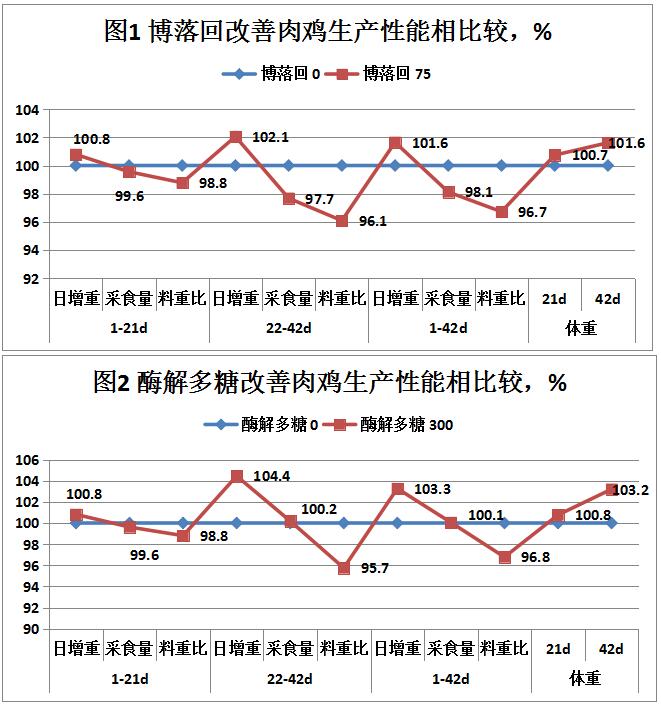
The effects of yeast polysaccharides and Boluohui on the production performance of goods are shown in Table 2. The effects of adding 75 mg/kg of Boluohui extract or 300 mg/kg of fermented polysaccharides on the production performance of broiler chickens are shown in Table 1, Table 2, Figures 1 and 2. According to the analysis of variance, adding 75 mg/kg of Boluohui extract or 300 mg/kg of fermented polysaccharides to broiler chickens had no significant effect on daily weight gain and feed intake from 1-21 days, 22-42 days, and 1-42 days, but significantly increased body weight by 21 days. Adding 75mg/kg Boluohui extract or 300mg/kg fermented polysaccharides separately to broiler chickens can significantly reduce the feed to weight ratio from 1-21 days and 1-42 days (p<0.05), and there is a significant trend of reducing the feed to weight ratio from 22-42 days (p=0.084, 0.059). There was no significant difference in the addition of both.
From a numerical analysis perspective, with the control group at 100%, without adding Boluohui and with the addition of 300 mg/kg fermented polysaccharides, daily weight gain increased by 1.5%, 7.9%, and 5.8% on days 1-21, 22-42, and 1-42, respectively. The feed to weight ratio decreased by 1.7%, 7.2%, and 5.4%, respectively. The body weight of broiler chickens increased by 1.5% and 5.7% on days 21 and 42, respectively; Adding 75 mg/kg of Boluohui extract without adding fermented polysaccharides increased daily weight gain by 1.5%, 5.5%, and 4.2% on days 1-21, 22-42, and 1-42, respectively. Feed intake decreased by 0.2%, 2.4%, and 1.9%, and feed to weight ratios decreased by 1.7%, 6.9%, and 5.5%, respectively. Body weight of broiler chickens increased by 1.4% and 4.1% on days 21 and 42, respectively; Adding 75 mg/kg of Boluohui extract and 300 mg/kg of fermented polysaccharides increased daily weight gain by 1.6%, 6.7%, and 5.0% on days 1-21, 22-42, and 1-42, respectively. Feed intake decreased by 0.8%, 2.1%, and 1.8%, and feed to weight ratios decreased by 2.4%, 7.9%, and 6.3%, respectively. Body weight of broiler chickens increased by 1.5% and 4.9% on days 21 and 42, respectively.
The relative comparison of the effects of yeast polysaccharides and Boluohui on product production performance is shown in Figure 1 and Figure 2. Without adding Boluohui extract as 100%, adding 75 mg/kg Boluohui extract increased daily weight gain by 0.8%, 2.1%, and 1.6% on days 1-21, 22-42, and 1-42, respectively. Feed intake decreased by 0.4%, 2.3%, and 1.9%, and feed to weight ratios decreased by 1.2%, 3.9%, and 3.3%, respectively. The body weight of broiler chickens increased by 0.7% and 1.6% on days 21 and 42, respectively. By adding 300mg/kg of fermented polysaccharides without adding any, the daily weight gain increased by 0.8%, 4.4%, and 3.3% on days 1-21d, 22-42, and 1-42, respectively. The feed to weight ratio decreased by 1.2%, 4.3%, and 3.2%, respectively. The body weight of broiler chickens increased by 0.8% and 3.2% on days 21 and 42, respectively.
3 Conclusion
Adding 75 mg/kg Boluohui extract or 300 mg/kg fermented polysaccharides separately to the diet can significantly improve the production performance of broiler chickens, but it has a certain impact on feed intake. The effect of adding the two in combination is not as good as adding them separately, and the optimal concentrations of the two in combination still need to be studied.
Table 1 Experimental Diet Composition and Nutritional Level
Raw materials,% | 1-21d | 22-42d | Nutritional level,% | 1-21d | 22-42d |
Corn | 55.60 | 55.20 | ME,kcal/kg | 2890 | 3210 |
Expanded soybean meal/46% | 29.00 | 24.00 | CP | 21.50 | 19.50 |
Cottonseed meal | 2.50 | 3.00 | Calcium | 0.96 | 0.84 |
Wheat flour | 4.00 | 4.00 | Total phosphorus | 0.66 | 0.55 |
Hydrolyzed feather powder | 1.50 | 1.50 | Lysine | 1.45 | 1.40 |
Calcium hydrogen phosphate/16.5% | 0.90 | 0.80 | Methionine | 0.54 | 0.50 |
Stone powder | 1.50 | 1.50 | Threonine | 0.91 | 0.80 |
Bentonite | 1.00 | 1.00 | |||
Soybean oil | 2.00 | 7.00 | |||
Pre mixed material | 2.00 | 2.00 | |||
Total | 100.00 | 100.00 |
Table 2: Effects of Yeast Polysaccharides and Boluohui on Product Production Performance
Macleaya cordata mg/kg | Yeast products mg/kg | 1-21d | 22-42d | 1-42d | Weight, g/piece | |||||||
Daily gain g/d | Feed intake g/d | F/G | Daily gain g/d | Feed intake g/d | F/G | Daily gain g/d | Feed intake g/d | F/G | 21d | 42d | ||
0 | 0 | 37.22 | 49.11 | 1.320 | 75.61 | 159.79 | 2.117 | 56.42 | 104.45 | 1.853 | 830.6 | 2418.5 |
300 | 37.79 | 49.03 | 1.297 | 81.60 | 159.92 | 1.964 | 59.70 | 104.47 | 1.752 | 842.6 | 2556.3 | |
75 | 0 | 37.78 | 49.00 | 1.297 | 79.76 | 155.92 | 1.971 | 58.77 | 102.46 | 1.751 | 842.4 | 2517.5 |
300 | 37.82 | 48.71 | 1.288 | 80.69 | 156.38 | 1.950 | 59.25 | 102.54 | 1.736 | 843.2 | 2537.6 | |
SEM | 0.094 | 0.093 | 0.003 | 0.878 | 0.927 | 0.023 | 0.450 | 0.462 | 0.014 | 1.327 | 18.881 | |
pooled | ||||||||||||
Macleaya cordata | 0 | 37.50 | 49.07 | 1.309 | 78.61 | 159.85 | 2.041 | 58.06 | 104.46 | 1.802 | 836.6 | 2487.4 |
75 | 37.80 | 48.85 | 1.293 | 80.23 | 156.15 | 1.961 | 59.01 | 102.50 | 1.743 | 842.8 | 2527.5 | |
Enzymatic hydrolysis of polysaccharides | 0 | 37.50 | 49.06 | 1.308 | 77.69 | 157.85 | 2.044 | 57.59 | 103.46 | 1.802 | 836.5 | 2468.0 |
300 | 37.80 | 48.87 | 1.293 | 81.14 | 158.15 | 1.957 | 59.47 | 103.51 | 1.744 | 842.9 | 2546.9 | |
p-value | ||||||||||||
Macleaya cordata + vs - | 0.131 | 0.257 | 0.012 | 0.362 | 0.052 | 0.084 | 0.293 | 0.039 | 0.042 | 0.024 | 0.293 | |
Enzymatic hydrolysis of polysaccharides + vs - | 0.119 | 0.326 | 0.013 | 0.056 | 0.874 | 0.059 | 0.042 | 0.954 | 0.046 | 0.020 | 0.042 | |
Macleaya cordata vs Enzymatic hydrolysis of polysaccharides | 0.167 | 0.589 | 0.257 | 0.156 | 0.927 | 0.151 | 0.126 | 0.972 | 0.136 | 0.039 | 0.126 | |
Table 3: Effects of Yeast Polysaccharides and Boluohui on Product Production Performance
Macleaya cordata mg/kg | Yeast products mg/kg | 1-21d | 22-42d | 1-42d | Weight | |||||||
Daily gain | Feed intake | F/G | Daily gain | Feed intake | F/G | Daily gain | Feed intake | F/G | 21d | 42d | ||
Using blank control as 100% | ||||||||||||
0 | 0 | 100.0 | 100.0 | 100.0 | 100.0 | 100.0 | 100.0 | 100.0 | 100.0 | 100.0 | 100.0 | 100.0 |
300 | 101.5 | 99.8 | 98.3 | 107.9 | 100.1 | 92.8 | 105.8 | 100.0 | 94.6 | 101.5 | 105.7 | |
75 | 0 | 101.5 | 99.8 | 98.3 | 105.5 | 97.6 | 93.1 | 104.2 | 98.1 | 94.5 | 101.4 | 104.1 |
300 | 101.6 | 99.2 | 97.6 | 106.7 | 97.9 | 92.1 | 105.0 | 98.2 | 93.7 | 101.5 | 104.9 | |
Using Boluohui or enzymatically hydrolyzed polysaccharides as 100% | ||||||||||||
Macleaya cordata | 0 | 100 | 100 | 100 | 100 | 100 | 100 | 100 | 100 | 100 | 100 | 100 |
75 | 100.8 | 99.6 | 98.8 | 102.1 | 97.7 | 96.1 | 101.6 | 98.1 | 96.7 | 100.7 | 101.6 | |
Enzymatic hydrolysis of polysaccharides | 0 | 100 | 100 | 100 | 100 | 100 | 100 | 100 | 100 | 100 | 100 | 100 |
300 | 100.8 | 99.6 | 98.8 | 104.4 | 100.2 | 95.7 | 103.3 | 100.1 | 96.8 | 100.8 | 103.2 | |