Sun Guangchao, Li Zhaoyong, Zhu Kaizhang, Ming Quan, Yang Zaibin
SD BIOTECH GROUP Shandong Agricultural University
Abstract: In order to study the improvement of summer heat stress production performance and economic benefits of Yanning 10 in commercial laying hens. 10300 50 week old Nongda No.3 commercial laying hens were selected for the experiment and fed with a diet supplemented with 500g/kg of Yanning 10 on top of the basic diet. Divided into a pre trial period (1 week) and a formal period (6 weeks). The results showed that adding 10500 g/kg of Yanning to the diet of commercial laying hens under summer heat stress could reduce the rate of unqualified eggs, mortality rate, and feed egg ratio. However, the egg production rate and egg production showed a decrease in numerical values. Compared with the control group, the feed egg ratio of laying hens fed 10500 g/kg of Yanning for 6 consecutive weeks decreased from 2.62 to 2.38, a decrease of 9.1%; The rate of unqualified eggs decreased from 0.51% to 0.30%, a decrease of 41.2%; The egg production rate has decreased from 73% to 69%.
This proves that adding 10500 g/kg of Yanning to the diet of commercial laying hens under summer heat stress has the effect of reducing the rate of unqualified eggs, mortality rate, and feed egg ratio, and improving the deposition of feed nutrients in eggs; And it also has the effect of slowing down the decrease in egg production rate under heat stress, improving the economic benefits of commercial laying hens. With the extension of feeding time, the effect becomes more apparent. There are many additives and methods for heat stress resistance in summer, and it is very difficult to completely eliminate the side effects of heat stress. Adding 10500 g/kg of Yanning can reduce the number of unqualified eggs, decrease the feed to egg ratio, and increase economic benefits. Therefore, it should be a breeding method worth trying.
Keywords: Yanning 10; layer; Production performance and economic benefits
1. Materials and Methods
1.1 Test Materials
Yanning 10: Provided by SD BIOTECH GROUP
1.2 Experimental animals and design
10300 50 week old Nongda No.3 commercial laying hens were selected and fed with Yanning 10 diet supplemented with 500g/kg of basic diet. The trial chickens were housed in cages, freely fed and watered, exposed to 16 hours of light per day (with a light intensity of 15lx), and maintained at a temperature of 25-35 ℃ for a period of 6 weeks. At 50 weeks of age, the basic production level of the chicken flock was recorded as the baseline before the experiment (0 weeks). Starting from 51 weeks of age, the experimental group began feeding the experimental diet supplemented with Yanning 10.
1.3 Measurement indicators
During the experiment, production performance (including egg production rate, egg weight, unqualified egg rate, feed intake, and mortality rate) was recorded daily on a treatment by treatment basis (without repetition), and the weekly average was calculated.
Average egg weight=total egg weight/number of eggs
Egg production rate=Total egg production/Total number of chickens x 100%
Egg production=Egg laying rate x Average egg weight x 100%
Unqualified egg rate=number of unqualified eggs/total number of eggs × 100%
1.4 Data Analysis
Calculate the average value of each indicator based on the processing unit. Due to the possible differences in production performance between egg laying chicken flocks during the initial stage of the experiment (0 week) (due to different breeding environments), in order to compare at the same starting point, the 0 week data was taken as 100%. The weekly data of any week (n weeks) in the formal experiment was compared with that of 0 week (n weeks/0 weeks × 100) to obtain the relative values of various production performance indicators for each experimental week. The relative values of production performance for each week (0, 1, 2, 3, 4, 5, 6 weeks) were used to explore the economic benefits that may arise from the application of Yanning 10 egg laying chickens. Due to the lack of repetition, no significance test was conducted on the results, only a pattern analysis was performed.
2 Results and Analysis
2.1 Analysis of Egg Production Rate
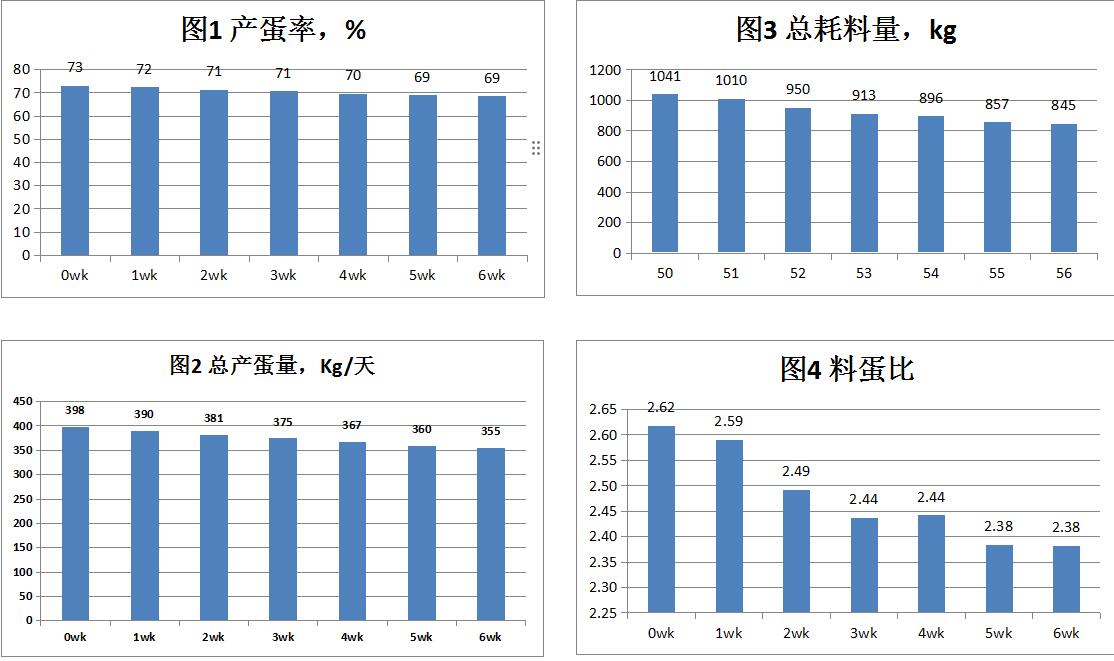
The effect of adding 10-500 g/kg of Yanning to the diet on the egg production rate of commercial laying hens under summer heat stress is shown in Tables 1 and 2 and Figures 1 and 8. According to Tables 1 and 2, as well as Figures 1 and 8, the egg production rate shows a decreasing trend with increasing age. Taking Experiment 0kw as 100%, the egg production rates were 99%, 98%, 97%, 95%, 94%, and 94% at 1 week, 2 weeks, 3 weeks, 4 weeks, 5 weeks, and 6 weeks, respectively. Numerical analysis shows a decrease, which is due to the fact that the experiment was conducted in early summer (June July) and the laying hens exhibited heat stress syndrome during egg production.
2.2 Analysis of Egg Production
The effect of adding 10-500 g/kg of Yanning to the diet on the egg production of commercial laying hens under summer heat stress is shown in Tables 1 and 2 and Figures 2 and 8. From Tables 1 and 2, as well as Figures 2 and 8, it can be seen that as the age increases, the egg production tends to decrease. Taking Experiment 0kw as 100%, the egg production rates at 1 week, 2 weeks, 3 weeks, 4 weeks, 5 weeks, and 6 weeks are 98%, 96%, 94%, 92%, 90%, and 89%, respectively. Numerical analysis shows a decrease, which is also due to the fact that the experiment was conducted in early summer (June July) and the laying hens exhibited heat stress syndrome.
2.3 Analysis of Unqualified Egg Rate
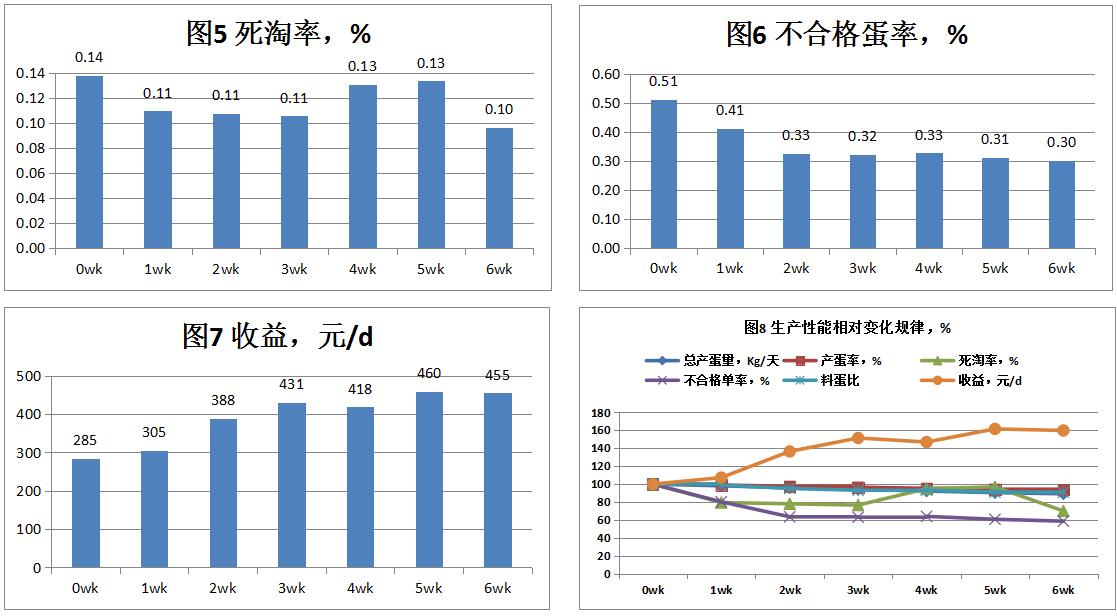
The effect of adding 10-500 g/kg of Yanning to the diet on the rate of unqualified eggs in commercial laying hens under summer heat stress is shown in Tables 1 and 2 and Figures 6 and 8. From Tables 1 and 2, as well as Figures 6 and 8, it can be seen that the rate of unqualified eggs shows a significant downward trend with increasing age. Taking Experiment 0week as 100%, the rates at 1week, 2week, 3week, 4week, 5week, and 6week were 80%, 64%, 63%, 64%, 61%, and 59%, respectively. Compared with 0week, the rate of unqualified eggs at 6week decreased by 41%. This indicates that adding Yanning 10 to the diet of commercial laying hens under summer heat stress has a significant effect on reducing the rate of unqualified eggs and improving egg quality.
2.4 Analysis of feed to egg ratio
The effects of adding 10-500 g/kg of Yanning to the diet on the feed egg ratio of commercial laying hens under summer heat stress are shown in Tables 1, 2, and Figure 4. From Tables 1, 2, and Figure 4, it can be seen that with increasing age, the feed to egg ratio shows a significant downward trend. Taking Experiment 0kw as 100%, the ratios at 1kw, 2kw, 3kw, 4kw, 5kw, and 6kw were 99%, 95%, 93%, 93%, 91%, and 91%, respectively. Compared with 0kw, the ratio decreased by 9% at 6kw. This indicates that adding Yanning 10 to the diet of commercial laying hens under summer heat stress has a significant effect on reducing the feed to egg ratio and promoting the deposition of feed nutrients in the eggs.
2.5 Comprehensive evaluation and benefit analysis
The decrease in egg production rate and egg production of laying hens in summer is a comprehensive manifestation of heat stress in laying hens. This experiment fed a diet supplemented with 500 g/kg of Yanning 10 for 6 weeks. Although the decline in egg production performance was not completely avoided, it can be seen from Figure 8 that the two lines of egg production and egg production rate showed a relatively flat downward trend, and the rate of unqualified eggs decreased rapidly. Due to the reduction in feed consumption, the feed to egg ratio decreased, resulting in a significant increase in economic benefits. Taking the experiment with 0 kg as 100%, the rates for 1 week, 2 weeks, 3 weeks, 4 weeks, 5 weeks, and 6 weeks were 107%, 136%, 151%, 147%, 161%, and 160%, respectively. Therefore, there are many anti heat stress additives and methods in summer, and it is very difficult to completely eliminate the side effects of heat stress. As long as they can be reduced, the benefits can be increased, and some production indicators can be improved, it should be worth trying.
3 Conclusion
Adding Yanning 10500 g/kg to the diet of laying chickens under summer heat stress has a significant effect on reducing the rate of unqualified eggs.
Adding 10-500 g/kg of Yanning to the diet of laying chickens under summer heat stress has the effect of reducing the feed to egg ratio and promoting the deposition of feed nutrients in the eggs..
3.3 Under summer heat stress, the addition of Yanning 10500 g/kg to the diet of laying chickens showed a significant improvement in economic benefits, although there was a decreasing trend in egg production rate and quantity.
The addition of Yanning 10500 g/kg to the diet of laying hens under summer heat stress resulted in different egg production rates and egg production compared to previous experimental results, which may be caused by summer heat stress, but the specific reasons need further exploration.
There are many additives and methods for heat stress resistance in summer laying hens, and it is difficult to completely eliminate the side effects of heat stress. Adding 10 500 g/kg of Yanning resulted in a decrease in unqualified eggs, a decrease in feed to egg ratio, and an increase in economic benefits. This should be a breeding method worth trying.
Table 1: Analysis of the Improvement of Egg Production Performance and Benefits of Yan Ning 10 in Summer (under Heat Stress) for Egg laying Chickens
Total egg production, kg/day | Egg production rate,% | Dead Taobao rate,% | Unqualified egg rate,% | Ratio of feed to egg | Revenue,RMB/d | |
0wk | 398 | 73 | 0.14 | 0.51 | 2.618 | 285 |
1wk | 390 | 72 | 0.11 | 0.41 | 2.590 | 305 |
2wk | 381 | 71 | 0.11 | 0.33 | 2.492 | 388 |
3wk | 375 | 71 | 0.11 | 0.32 | 2.437 | 431 |
4wk | 367 | 70 | 0.13 | 0.33 | 2.442 | 418 |
5wk | 360 | 69 | 0.13 | 0.31 | 2.384 | 460 |
6wk | 355 | 69 | 0.10 | 0.30 | 2.382 | 455 |
Table 2 Relative values of Yanning 10 improving the egg laying performance and benefits of laying hens in summer (under heat stress),%
Total egg production, kg/day | Egg production rate,% | Dead Taobao rate,% | Unqualified egg rate,% | Ratio of feed to egg | Revenue,RMB/d | |
0wk | 100 | 100 | 100 | 100 | 100 | 100 |
1wk | 98 | 99 | 79 | 80 | 99 | 107 |
2wk | 96 | 98 | 78 | 64 | 95 | 136 |
3wk | 94 | 97 | 77 | 63 | 93 | 151 |
4wk | 92 | 95 | 95 | 64 | 93 | 147 |
5wk | 90 | 94 | 97 | 61 | 91 | 161 |
6wk | 89 | 94 | 70 | 59 | 91 | 160 |