Li Zhaoyong, Jiang Feng, Yang Hengwei, wish for success, Li Jingwei, Yang Zaibin
SD BIOTECH GROUP
Linyi Fengmu Feed Co., Ltd., Shandong Agricultural University
Abstract: In order to study the efficacy of stress Ning C in improving the production performance, meat quality, and economic benefits of meat ducks. This study selected 40000 healthy 1-day-old meat ducks and divided them into two treatments. A control group of 20000 ducks were raised in a duck house and fed with a basic diet (nutritional level of commercial feed); The experimental group, consisting of 20000 individuals, was housed in two duck houses, with 10000 individuals per house. The control group was fed a basic diet plus 500 g/ton of stress Ning C. The control group was slaughtered at 28 days, while the experimental group had two duck houses slaughtered at 28 and 29 days, respectively. Experimental ducks were raised on a flat net and fed with pellet feed, with consistent dietary composition and nutritional levels between treatments. Experiment 28 days, 20 ducks were randomly selected from each treatment for slaughter testing to determine meat production performance, organ index, muscle vitamin E, meat color, and antioxidant indicators. The research results show that, in terms of cluster numerical analysis, after 28 days of slaughter of meat ducks, with the production performance indicators of the control group being 100%, the slaughter weight and daily weight gain increased by 1.6% after adding stress Ning C, the feed intake decreased by 0.3%, the feed to weight ratio decreased by 1.9%, and the survival rate increased by 1.4%. After 28 days of slaughter with the addition of stress Ning C, the chest muscle rate and leg muscle rate increased by 2.7% and 2.2%, respectively. Statistical analysis showed that compared with the control group, the addition of stress Ning C to the diet had no effect on the yellowing value (b value) of meat duck pectoral muscles (p>0.05), but significantly reduced the brightness value (L value) of pectoral muscles, increased the redness value (a value) and meat color score (p<0.05). Taking the production performance indicators of the control group as 100%, the addition of stress Ning C increased the comprehensive muscle color score by 37.8%. Based on the 28 day slaughter of meat ducks, Stress Ning C can increase the slaughter weight and survival rate of meat ducks, improve the feed efficiency of meat ducks by 115.01 yuan/ton, and increase the value of meat duck breeding by 0.68 yuan/duck. Adding stress Ning C to meat duck feed has the potential to improve the production and meat production performance of meat ducks; Has a significant effect on improving the color of meat duck muscles; It has the effect of increasing economic benefits.
Keywords: Stress Ning C, Meat Duck, Meat Production Performance, Color Value, Economic Benefits
1 Materials and Methods
1.1 Test Materials
Stress Ning C: Compound product of trans anise ether. By SD BIOTECH GROUP
1.2 Experimental animals and design
Select 40000 healthy 1-day-old meat ducks (Anhui Qiangying Duck Industry Group Co., Ltd.) and divide them into 2 treatments. A control group of 20000 ducks were raised in a duck house and fed with a basic diet (nutritional level of commercial feed); The experimental group, consisting of 20000 individuals, was housed in two duck houses, with 10000 individuals per house. The control group was fed a basic diet plus 500 g/ton of stress Ning C. The control group was slaughtered at 28 days, while the experimental group had two duck houses slaughtered at 28 and 29 days, respectively. Experimental ducks were raised on a flat net and fed with pellet feed, with consistent dietary composition and nutritional levels between treatments. The composition and nutritional levels of the basic feed are shown in Table 2.
1.3 Measurement indicators
Production performance: Record feed intake on a daily basis in units of repetition, and weigh the abdomen at the beginning and end of the experiment. Calculate the average daily feed intake, average daily weight gain, and feed to gain ratio. Record the mortality rate.
Meat production performance: At the end of the experimental period, 10 pigs were randomly selected from the experimental group and the control group for slaughter, and the semi clean bore rate, full clean bore rate, leg muscle rate, and chest muscle rate were measured.
Antioxidant performance: At the end of the experimental period, serum and liver antioxidant indicators (SOD, GSH pX, MDA) were measured using test chickens that measured meat production performance.
Vitamin E: At the end of the trial period, the content of vitamin E in the chest, leg, and liver muscles will be measured using test chickens with meat production performance.
Meat color: At the end of the experimental period, the chest muscle color values (L value, a value, and b value) will be measured using test chickens with meat production performance.
1.4 Data statistics and analysis
The data was analyzed using SAS 9.2 software, and Duncan's multiple range test was used to compare the mean values, with a significance level of p<0.05.
2 Results and Analysis
2.1 Comparative analysis of meat production performance
The effect of adding 500 g of stress Ning C per ton of compound feed on the production performance of meat ducks is shown in Tables 3 and 4, as well as Figure 1. The analysis of the results showed that for meat ducks slaughtered for the same 28 days, with the control group's production performance indicators at 100%, the addition of stress Ning C increased slaughter weight and daily weight gain by 1.6%, reduced feed intake by 0.3%, decreased feed to weight ratio by 1.9%, and increased survival rate by 1.4%. The control group was slaughtered at 28 days, while the experimental group was compared using the average values of two replicates slaughtered at 28 and 29 days. Taking the production performance indicators of the control group as 100%, the addition of stress Ning C increased the slaughter weight and daily weight gain by 4.7% and 2.9%, respectively. The daily average feed intake increased by 1.6%, the feed to weight ratio decreased by 1.2%, and the survival rate increased by 1.1%. This indicates that adding stress Ning C to meat duck feed can improve weight gain, increase feed efficiency, and reduce mortality rates.
2.2 Comparative analysis of meat production performance
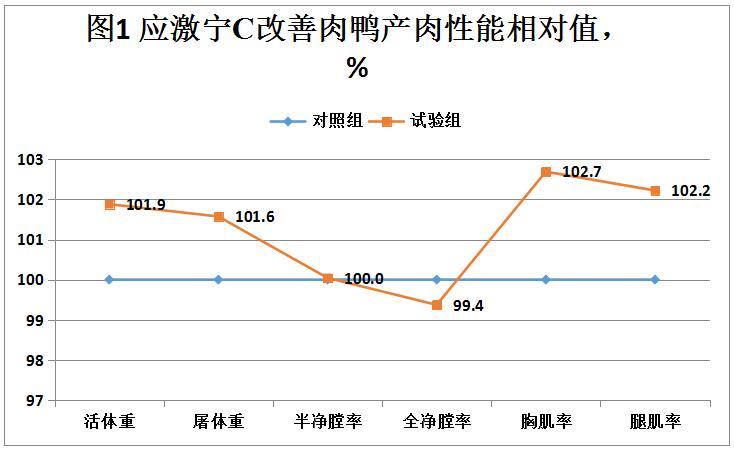
The effect of adding 500 g/ton of stress Ning C to the diet of meat ducks on their meat production performance is shown in Table 5. The analysis of variance results showed that compared with the control group, the addition of stress Ning C to the diet did not significantly affect the meat production performance of meat ducks (p>0.05). In terms of numerical comparison, with the production performance indicators of the control group being 100%, the semi clean bore rate and full clean bore rate after adding stress Ning C were 100% and 99.4%, respectively. The experimental group and the control group were almost identical; The chest muscle rate and leg muscle rate are 102.7% and 102.2%, respectively. This indicates that adding stress Ning C to meat duck feed may improve the weight of leg and chest muscles.
2.3 Comparative analysis of chromaticity values of chest muscles
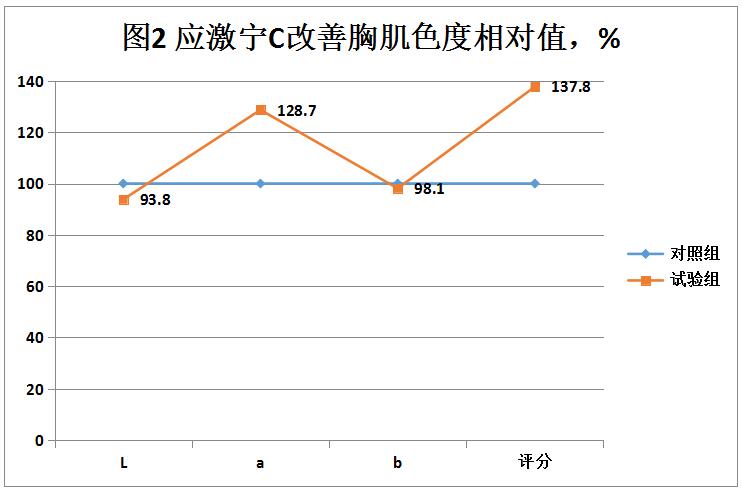
The effect of adding 500g/ton of stress Ning C to the diet of meat ducks on breast muscle color is shown in Table 6 and Figure 2. The result analysis showed that compared with the control group, the addition of stress Ning C to the diet had no effect on the yellowing value (b value) of meat duck pectoral muscles (p>0.05), but significantly reduced the brightness value (L value) of pectoral muscles, increased the redness value (a value) and meat color score (p<0.05). Taking the production performance indicators of the control group as 100%, the addition of stress Ning C increased the comprehensive muscle color score by 37.8%. Adding stress Ning C to the feed of meat ducks can improve the color of their chest muscles, and stress Ning C has a significant effect on improving the color of meat ducks' muscles.
2.4 Evaluation and Analysis of Economic Benefits of Stress Ning C
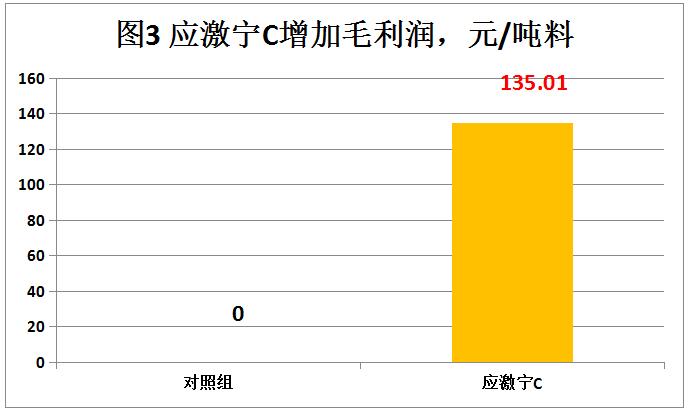
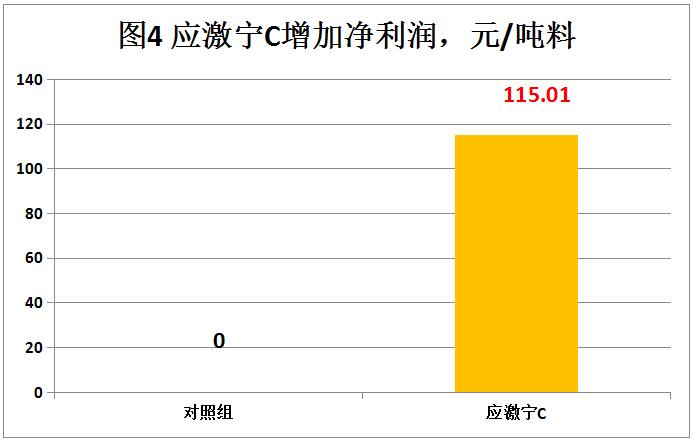
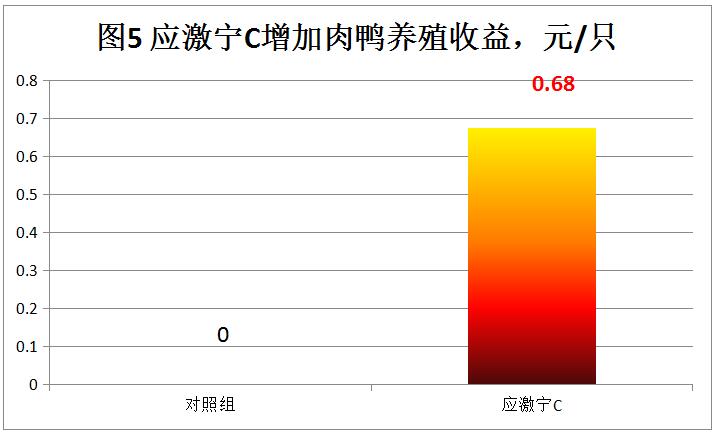
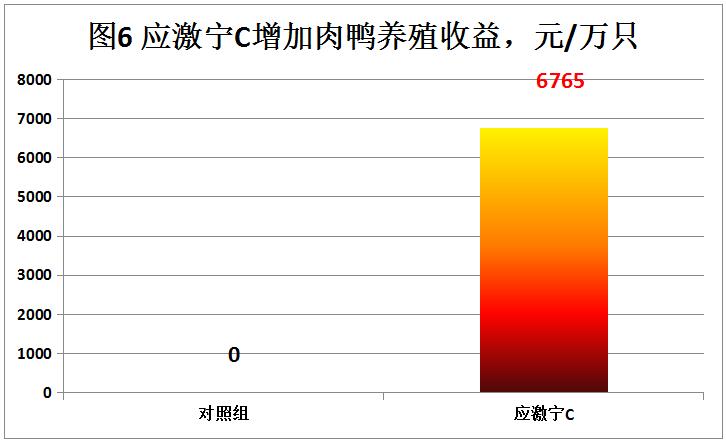
Based on the feed intake, slaughter weight, and survival rate of 28 day slaughtered meat ducks, the cost and benefit analysis of feeding and not feeding stressed Ning C to meat ducks were calculated, as shown in Table 7 and Figure 3-6. Calculated based on feed cost of 2.7 yuan/kg, duck fry cost of 3.5 yuan/unit, drug cost of 0.4 yuan/unit, and selling price of 6.8 yuan/kg for live ducks, feeding meat ducks with the stressed Ning C diet can increase the value of each ton of compound feed by 135.01 yuan/ton. The unit price of stress Ning C is estimated to be 40 yuan/kg, and the addition amount is estimated to be 500 g/ton. The cost that stress Ning C can increase is 20 yuan/ton; After deducting the cost of Stress Ning C, the economic benefit of adding 115.01 yuan/ton per ton of meat duck compound feed can be achieved; Converted into meat duck farming, it can increase the value of meat duck farming by 0.68 yuan per duck, and for every 10000 meat ducks, it may increase the income by 6765 yuan. This indicates that Stress Ning C can improve the breeding efficiency of meat ducks by increasing their body weight and survival rate.
3 Conclusion
3.1 Adding stress Ning C to meat duck feed has the potential to improve production and meat production performance. Hope to improve the weight gain rate by more than 1%; Reduce the material to weight ratio by more than 1%; The chest muscle rate and leg muscle rate increased by more than 2% respectively; The survival rate increased by more than 1%. Detailed data can be verified through large-scale production.
3.2 Adding stress Ning C to meat duck feed has the potential to improve the quality of duck meat. It can reduce muscle brightness, increase redness, and improve the comprehensive meat color score. Stress Ning C has a significant effect on improving the color of meat duck muscles.
3.3 Stress Ning C can improve the efficiency of meat duck breeding by increasing the body weight and survival rate of meat ducks.
Table 1 Stress Ning C Test Design
Handle | Stress Ning C Addition Level | Repetitions | Number of chickens, only/Repeated | Number of chickens, per treatment |
1 | Control group+0 g/ton | 1 | 20000 | 20000 |
2 | Control group+500 g/ton | 2 | 10000 | 20000 |
Amount to | 40000 |
Table 2 Basic Diet Composition and Nutritional Level
Raw material | Meat Duckling (1-14d) | Meat Duck (15-28d) | Nutritional indicator | Meat Duckling (1-14d) | Meat Duck (15-28d) |
Wheat | - | 45.00 | ME,kcal/kg | 2750 | 3160 |
Corn | 44.50 | 16.00 | Crude protein | 18.5 | 17.5 |
Bran | 8.00 | - | Total calcium | 0.8 | 0.8 |
Middling | 10.00 | - | Phosphorus | 0.6 | 0.4 |
Distiller's grains | 15.00 | 7.50 | Lysine | 1.1 | 1.2 |
Soybean meal 46% | 11.50 | 6.50 | Methionine | 0.45 | 0.5 |
Spray pulp | - | 7.00 | Threonine | 0.7 | 0.8 |
Duck oil | - | 6.50 | |||
Sugar residue | 3.00 | 3.00 | |||
Soy sauce residue | 2.00 | 2.50 | |||
Feather Meal | 2.00 | 2.00 | |||
Stone powder | 1.50 | 1.31 | |||
Hydrogen calcium | 0.77 | 0.70 | |||
Lysine 70 | 0.60 | 0.75 | |||
Methionine | 0.13 | 0.17 | |||
Threonine | 0.07 | ||||
Premix | 1.00 | 1.00 | |||
Amount to | 100 | 100 |
Table 3 Comparison of Production Performance of Stress Ning C Meat Ducks (28 day synchronous slaughter, control and experiment both slaughtered after 28 days)
Handle | Selling weight, g/piece | Daily weight gain,g/d | Feed intake, g/piece | Feed intake, g/d | F/G | Survival rate,% |
Production performance at the time of slaughter | ||||||
Control group 28d | 1860 | 66.4 | 2954.4 | 105.5 | 1.61 | 97.1 |
Test group 28d | 1890 | 67.5 | 2946.7 | 105.2 | 1.58 | 98.5 |
Comparison of production performance during slaughter,% | ||||||
Control group 28d | 100 | 100 | 100 | 100 | 100 | 100 |
Test group 28d | 101.6 | 101.6 | 99.7 | 99.7 | 98.1 | 101.4 |
Table 4 Comparison of Production Performance of Stress Ning C Meat Ducks (Control Group at 28 Days, Experimental Group at 28 and 29 Days)
Handle | Selling weight | Daily weight gain | Feed intake | Average feed intake | F/G | Survival rate |
Production performance at the time of slaughter | ||||||
Control group | 1860 | 66.4 | 2954 | 105.5 | 1.61 | 97.10 |
Test group | 1948 | 68.3 | 3057 | 109.2 | 1.59 | 98.20 |
Comparison of production performance during slaughter,% | ||||||
Control group 28d | 100 | 100 | 100 | 100 | 100 | 100 |
Test group 28.5d | 104.7 | 102.9 | 103.5 | 101.6 | 98.8 | 101.1 |
Table 5 Comparative analysis of stress Ning C improving meat production performance of meat ducks
Handle | Living weight,g | Slaughter weight,g | Half bore rate,% | Full bore rate,% | Pectoral muscle rate,% | Leg muscle rate,% |
Comparison of Meat Production Performance | ||||||
Control group | 1567.83 | 1481.33 | 88.24 | 0.72 | 5.50 | 15.05 |
Test group | 1597.33 | 1504.67 | 88.28 | 0.71 | 5.65 | 15.38 |
SEM | 32.051 | 30.775 | 0.141 | 0.003 | 0.250 | 0.616 |
p-value | 0.655 | 0.713 | 0.897 | 0.476 | 0.773 | 0.791 |
Comparison of Meat Production Performance (100% without the Use of Stress Ning C) | ||||||
Control group | 100.0 | 100.0 | 100.0 | 100.0 | 100.0 | 100.00 |
Test group | 101.9 | 101.6 | 100.0 | 99.4 | 102.7 | 102.22 |
Table 6 Comparison and analysis of the improvement of chromaticity values of meat duck chest muscles by stress Ning C
Handle | L | a | b | 评分 |
Color value of pectoral muscle | ||||
Control group | 58.71 | 9.00 | 14.40 | 1.63 |
Test group | 55.07 | 11.58 | 14.13 | 2.24 |
SEM | 3.395 | 2.822 | 1.588 | 0.577 |
p-value | 0.015 | 0.035 | 0.676 | 0.016 |
Relative comparison of meat color (with no use of stress Ning C as 100%) | ||||
Control group | 100.0 | 100.0 | 100.0 | 100.0 |
Test group | 93.8 | 128.7 | 98.1 | 137.8 |
Table 7 Economic Evaluation of Feeding Meat Ducks with Stress Ning C per Ton of Full Price Feed
Cost and benefit indicators | Control group | Stress Ning C |
Feed accounting quantity,kg | 1000 | 1000 |
Material consumption, kg/piece | 2.954 | 2.947 |
Number of meat ducks that can be raised | 338.5 | 339.3 |
Survival rate of meat duck,% | 97.10 | 98.50 |
Quantity of slaughtered meat ducks | 328.7 | 334.2 |
Feed unit price,RMB/kg | 2.700 | 2.700 |
Feed cost,RMB/ton | 2700 | 2700 |
Duck fry unit price,RMB/piece | 3.50 | 3.50 |
Duck fry cost,RMBn/ton of feed | 1184.83 | 1187.65 |
Unit price of medication,RMB/piece | 0.40 | 0.40 |
Medical cost | 135.41 | 135.73 |
Selling weight, kg/piece | 1.86 | 1.89 |
Selling weight, Kg/ton of material | 611.4 | 631.7 |
Market price of meat duck,RMB/kg | 6.8 | 6.8 |
Meat and duck income,RMB/ton of feed | 4157.5 | 4295.6 |
Profit on meat and duck feathers,RMB/ton of feed | 137.24 | 272.25 |
Experimental group - control group increased gross profit,RMB | 0 | 135.01 |
Unit price of Stress Ning C,RMB/kg | 40 | 40 |
Addition amount of stress Ning C, kg/ton of material | 0 | 0.5 |
Stress Ning C cost,RMB/ton of material | 0 | 20 |
Net profit of meat and duck,RMB/ton | 137.24 | 252.25 |
Experimental group - control group increases net profit,RMB/ton of material | 0 | 115.01 |
Experimental group - control group increased net profit,RMB/piece | 0 | 0.68 |
Experimental group - control group increased net profit,RMB/10000 units | 0 | 6765 |