Cui Guishan
SD BIOTECH GROUP
Abstract: In order to study the effect of adding Yanning T1 to the diet under summer conditions on the production performance of meat rabbits, this experiment selected 2260 Yila meat rabbits at around 30 days old and added 1.0 g/kg Yanning T1 to the basic diet. Adopting a single factor comparative experimental method. The pre trial period is 5 days, and the main trial period is 33 days. Measure the diarrhea rate and mortality rate. The research results indicate that adding 1g/kg of Yanning T1 to the diet of growing meat rabbits under summer conditions can significantly reduce mortality and diarrhea rates; Compared with the control group, the mortality rate of meat rabbits fed with Yanning T1 (1.0 g/kg) for 5 consecutive weeks decreased from 16.87% to 4.34%, a decrease of 74.3%; The diarrhea rate decreased from 21.4% to 7.3%, a decrease of 65.8%; The overall survival rate increased from 84.9% to 95.75%, an increase of 12.8%. The research results have shown that adding 1.0 g/kg of Yanning T1 to the diet of Iraqi meat rabbits under summer conditions has the effect of reducing mortality and diarrhea rates. In the absence of antibiotic resistance in feed, there are many methods and additives to replace antibiotics in feed, and it is very difficult to fully achieve the effect of antibiotics. Adding 1.0 g/kg Yanning T1 significantly reduces mortality and increases economic benefits, making it a worthwhile feeding method to try.
Keywords: Yanning T1; rabbit; Production performance; economic performance
1. Materials and Methods
1.1 Test Materials
Yanning T1: Provided by SD BIOTECH GROUP
1.2 Experimental animals and design
Select 2260 30 day old Iraqi meat rabbits. The experimental group added 1.0g/kg of Yanning T1 to the basic diet. The experimental rabbits were housed in cages and allowed to freely feed and drink water. Epidemic prevention and rabbit house disinfection should be carried out according to normal procedures.
1.3 Test Method
Adopting a single factor comparative experimental method. At the age of 30 days, the basic production level of the rabbit population was recorded as the basis for the early stage of the experiment. The formal experiment began at 36 days of age, with the control group continuing to receive a basic diet and the experimental group starting to receive a diet containing Yanning T1 (1.0g/kg) for 33 consecutive days until slaughter. Calculate the daily diarrhea rate of each group of rabbits during the statistical experiment period; Record the daily number of deaths and calculate the mortality rate. The initial weight and feed intake were not statistically analyzed, therefore feed intake, daily weight gain, and feed to gain ratio were not analyzed. Record the weight of the slaughtered animal.
1.4 Data Analysis
During the experiment, calculate the weekly average values of various indicators for each group. Due to the lack of repetition in the experiment, no significance test was conducted on the results, and only a pattern analysis was performed.
2. Results and Analysis
2.1 Mortality Analysis
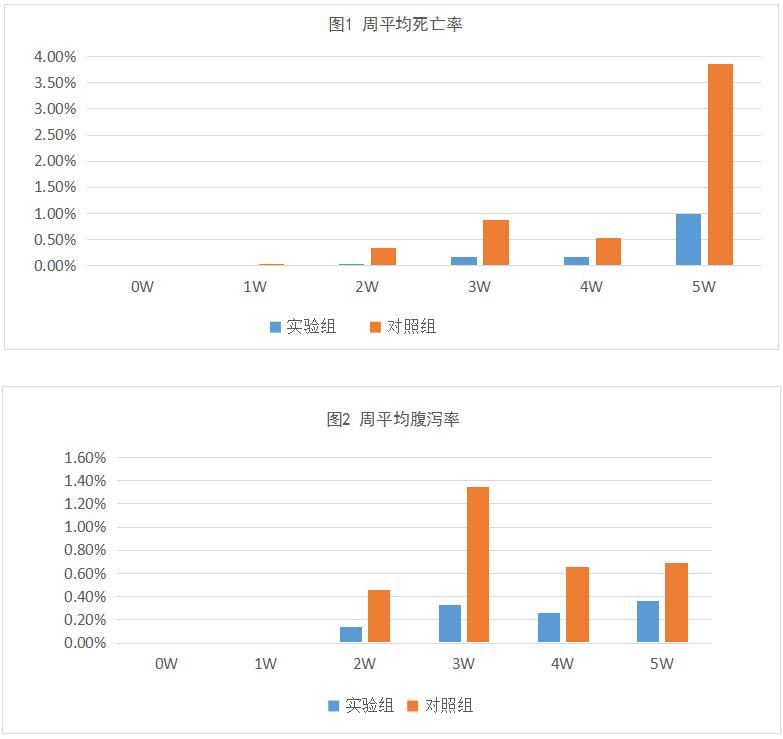
The effect of adding 1.0g/kg Yanning T1 to the diet of Iraqi meat rabbits under summer conditions on mortality is shown in Table 1. From the data, it can be seen that as the experiment progresses, the mortality rates of both the experimental group and the control group gradually increase. The change patterns are shown in Table 1 and Figure 1. It can be seen that the weekly average mortality rates of feeding Yanning T1 diet for 1-5 weeks were 0.03%, 0.04%, 0.18%, 0.18%, and 1.00%, respectively. The weekly average mortality rates of the control group were 0.04%, 0.35%, 0.88%, 0.53%, and 3.85%, respectively. Compared with the experimental group, the weekly average mortality rates of the control group were 33.33%, 88.72%, 79.61%, 66.04%, and 74.06% higher, respectively. The cumulative mortality rate was 16.87% in the control group and 4.34% in the experimental group. Throughout the entire experimental period, the cumulative mortality rate of the experimental group was 74.3% lower than that of the control group.
Numerically speaking, under summer conditions, adding 1.0g/kg of Yanning T1 to the diet of growing Iraqi meat rabbits significantly reduces mortality rates.
2.2 Analysis of Diarrhea Rate
The effect of adding 1.0 g/kg of Yanning T1 to the diet on the diarrhea rate of Iraq meat rabbits is shown in Table 1. The data in the table shows that as the age of the experimental rabbit population increases, the diarrhea rates in both the experimental group and the control group show an upward trend. The change pattern is shown in Table 1 and Figure 2. It can be seen that as the feeding time of Yanning T1 diet is prolonged, the diarrhea rate of the experimental group remains relatively stable, with diarrhea rates of 0.00%, 0.14%, 0.33%, 0.26%, and 0.37% at 1-5 weeks, respectively; The diarrhea rates in the control group were 0.00%, 0.46%, 1.35%, 0.65%, and 0.69%, respectively. Compared with the control group, the weekly average diarrhea rates in the experimental group were 0.00%, 69.53%, 75.43%, 60.43%, and 46.91% lower, respectively.
Numerically speaking, under summer conditions, adding 1.0g/kg of Yanning T1 to the diet of growing Iraqi meat rabbits significantly reduces the diarrhea rate.
2.3 Comprehensive evaluation and benefit analysis
In summer, with the increase of feeding age, the diarrhea rate and mortality rate of Yila meat rabbits tend to increase. In this experiment, meat rabbits were fed a diet supplemented with 0.1 g/kg of Yanning T1 for 5 weeks. Although it did not completely avoid a decrease in production performance, it can be seen from Figures 1 and 2 that the trend of diarrhea and mortality rates in the experimental group was relatively flat, resulting in considerable economic benefits. The average weight of slaughtered meat rabbits is 2kg per rabbit, calculated at a market price of 12 yuan/kg. Only the benefits generated by the increase in the final survival rate will be accounted for. According to the data of the experimental group, the survival rate of the experimental group is 95.6%, and the survival rate of the control group is 83.1%. The actual benefits will increase by 2.55 yuan per animal. If we calculate the reduction in feed waste and drug costs, the benefits will be even more significant.
There are many additives and methods for replacing antibiotics with meat rabbits under summer conditions. It is very difficult to achieve the same production results as using antibiotics. As long as the diarrhea rate and mortality rate can be reduced, the benefits will increase. This should be a breeding method worth trying.
3. Conclusion
Under summer conditions, adding 1.0 g/kg of Yanning T1 to the diet of Yila meat rabbits resulted in an average reduction of 50.5% in diarrhea rate compared to the control group. Therefore, Yanning T1 has a significant effect in reducing diarrhea.
Under summer conditions, adding 1.0 g/kg Yanning T1 to the diet of Yila meat rabbits resulted in a 74.3% reduction in mortality rate compared to the control group, and the mortality rate of meat rabbits was significantly reduced.
From a numerical perspective, adding 1.0 g/kg of Yanning T1 to the diet of Iraqi meat rabbits under summer conditions significantly improved the breeding efficiency of meat rabbits in the entire experiment.
3.4 There are many additives and methods for replacing antibiotics with meat rabbits in summer, and it is very difficult to fully achieve the effect of antibiotics. Adding 1.0 g/kg Yanning T1 can reduce diarrhea and mortality rates, increase economic benefits, and is a breeding method worth trying.
Table 1: Effect of Yanning T1 on the Production Performance of Ila Meat Rabbits
Mortality | Diarrhea | |||
Experimental group | Control group | Experimental group | Control group | |
0W | 0.00% | 0.00% | 0.00% | 0.00% |
1W | 0.03% | 0.04% | 0.00% | 0.00% |
2W | 0.04% | 0.35% | 0.14% | 0.46% |
3W | 0.18% | 0.88% | 0.33% | 1.35% |
4W | 0.18% | 0.53% | 0.26% | 0.65% |
5W | 1.00% | 3.85% | 0.37% | 0.69% |
Table 2 Analysis of the benefits of using Yanning T1 based on actual experimental data calculation
Item | Control | 炎宁T1 |
Feed consumption, g/animal/day | 125 | 125 |
Feed price, RM/kg | 2.7 | 2.7 |
Feed cost, RMB/piece/day | 0.34 | 0.34 |
Selling weight, g/piece | 2060 | 2050 |
Price, RMB/kg | 12 | 12 |
Survival rate,% | 84.9 | 95.7 |
Increase profit, RMB/10000 pieces | 25549 | |