Test time: May 14, 2024 to June 12, 2024
Test location: A large egg chicken farm in Guangdong Province
Summary:
The aim of this experiment is to investigate the effect of Yanning on the egg laying performance of laying hens in the late stage of egg production (335-364 days old). A large egg laying farm in Guangdong Province was selected, with 100000 laying hens. The experiment was divided into two stages: the first stage was fed with a basic diet at 335-349 days old, and the second stage was fed with Yanning at a dosage of 250g/t on top of the basic diet at 350-364 days old. Daily feed intake and egg production were recorded to determine egg laying performance. The egg production performance is as follows:
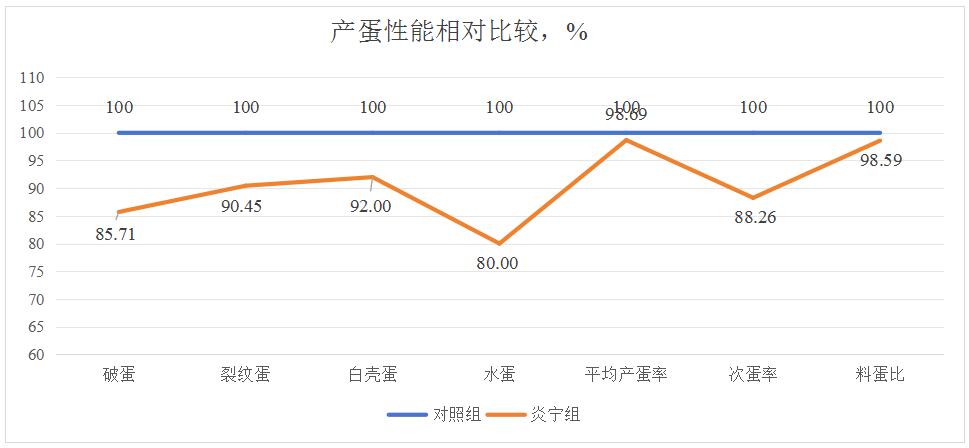
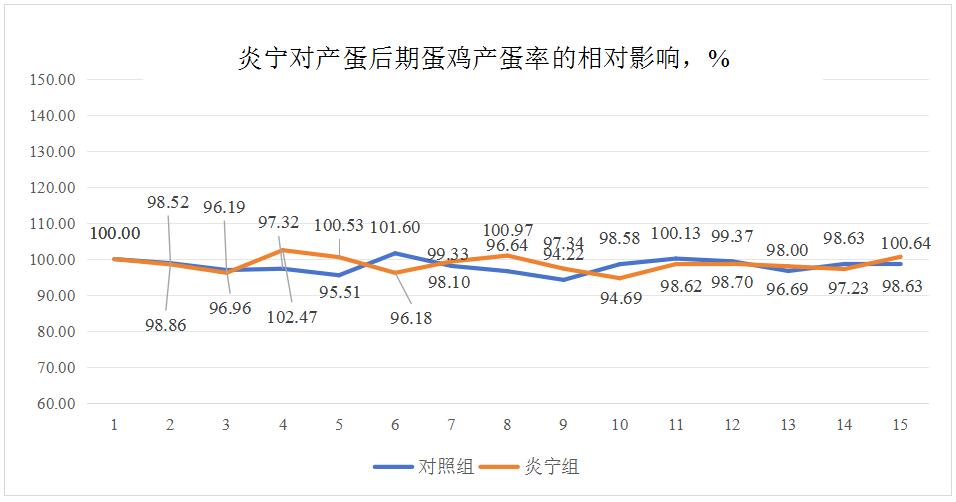
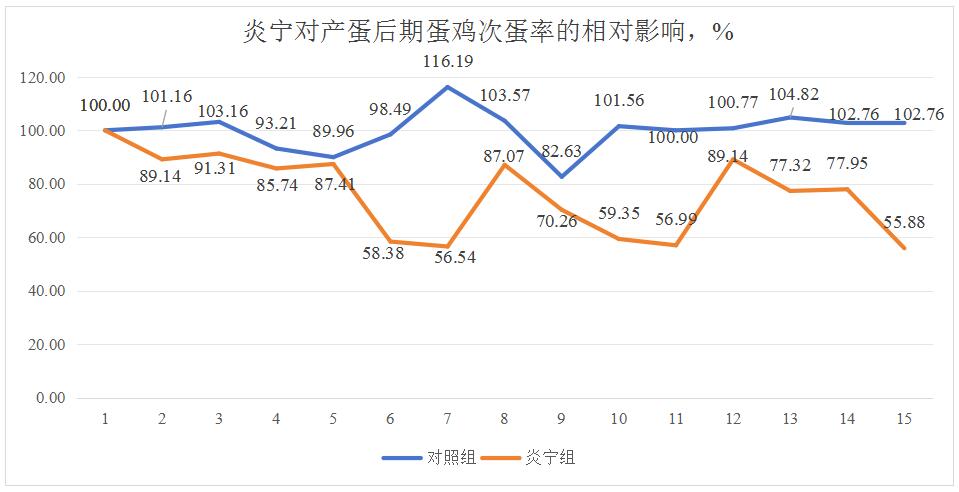
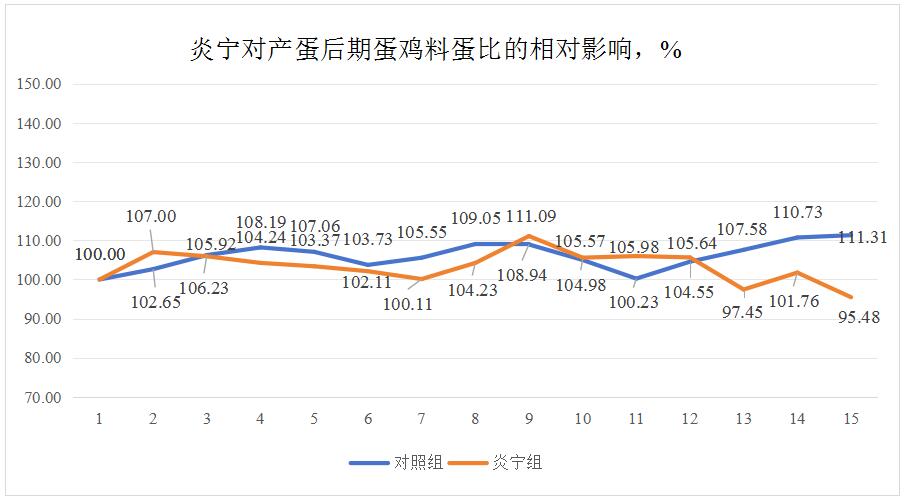
Compared with the first stage, the egg production rate remained stable after using Yanning, and the downward trend was significantly delayed. Taking all indicators in the first stage as 100%, the addition of Yanning reduced the number of cracked eggs by 14.3%, cracked eggs by 9.5%, white shell eggs by 8%, water eggs by 20%, the second egg rate by 12%, and the feed to egg ratio by 1.41%.
1.Materials and Methods
1.1 Test Materials
Yanning: Provided by Shengdao Biotechnology (Shandong) Group Co., Ltd
1.2 Experimental animals and design
Selecting 100000 laying hens from a large chicken farm in Guangdong, the experiment was divided into two stages. The first stage was fed with a basic diet at 335-349 days of age, which was recorded as the control group; At 350-364 days of age, the second stage is to add 250 g/t of Yanning to the basic diet, which is referred to as the Yanning group. Record daily feed intake and egg production, and measure egg production performance.
1.3 Measurement indicators
Egg production performance: Record daily feed intake and egg production status. Calculate egg production rate, second egg rate, average egg production rate, and feed to weight ratio.
2.Results and Analysis
Compared with the first stage, the egg production rate remained stable after using Yanning, and the downward trend was significantly delayed. Taking all indicators of the first stage as 100%, the addition of Yanning reduced the number of cracked eggs by 14.3%, cracked eggs by 9.5%, white shell eggs by 8%, water eggs by 20%, the second egg rate by 12%, and the feed to egg ratio by 1.41%.
3.Conclusion
During the use of Yanning, the temperature gradually increased compared to before use, and the humidity of the air also increased with the increase of rainfall. The climate conditions during the use of Yanning were relatively worse. At the same time, the egg laying performance and health status of the laying hens continued to decline with age in the later stage of egg production. After using Yanning, the overall production performance of the laying hens still improved significantly: broken eggs decreased by 14.3%, cracked eggs decreased by 9.5%, white shell eggs decreased by 8%, water eggs decreased by 20%, the second egg rate decreased by 12%, the feed egg ratio decreased by 0.03, the egg laying rate remained stable, and the downward trend was significantly delayed.
Table 1 Egg Production Performance
Group | Broken egg | Cracked egg | Eggs with white shells | Water eggs | Average egg production rate | Second egg rate | Ratio of feed to egg |
Control Group | 896 | 420 | 500 | 300 | 90.99% | 2.30% | 2.13 |
Yanning Group | 768 | 380 | 460 | 240 | 89.80% | 2.03% | 2.10 |
Table 2 Comparison of Egg Production Performance,%
Group | Broken egg | Cracked egg | Eggs with white shells | Water eggs | Average egg production rate | Second egg rate | Ratio of feed to egg |
Control Group | 100 | 100 | 100 | 100 | 100 | 100 | 100 |
Yanning Group | 85.71 | 90.45 | 92 | 80 | 98.69 | 88.26 | 98.59 |